


The Era of Smart Cell Has Arrived: How Physical AI Edge-side Wireless Intelligent Chips Restructure Next-Generation BMS?
Why Does BMS Need a Revolutionary Upgrade as Batteries Grow Larger?
Driven by the robust expansion of the new energy industry, new energy vehicles and advanced energy storage systems have propelled battery systems into a new phase featuring higher energy density and large-scale deployment. Passenger vehicles and energy storage stand as the two core application scenarios for batteries, accounting for nearly 90% of total market demand.
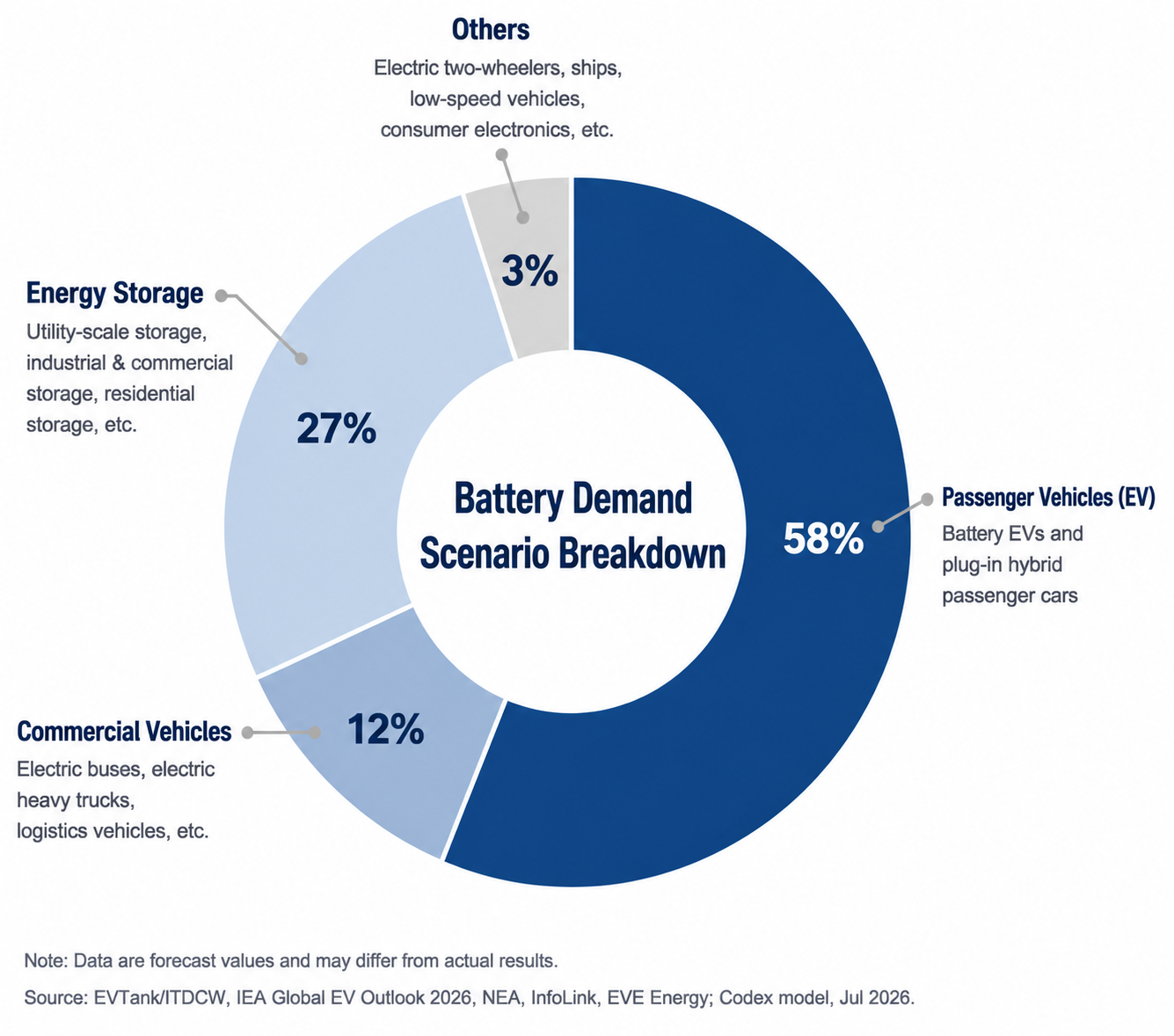
Breakdown of Battery Application Scenarios by Proportion
With the continuous scaling of battery deployment, wireless Battery Management System (wBMS) is accelerating industrialization. The global market size for wireless BMS System-on-Chip (SoC) is projected to reach approximately 30 billion RMB by 2030, with further growth fueled by electrification scenarios including robotics, low-altitude aircraft, and marine vessels.
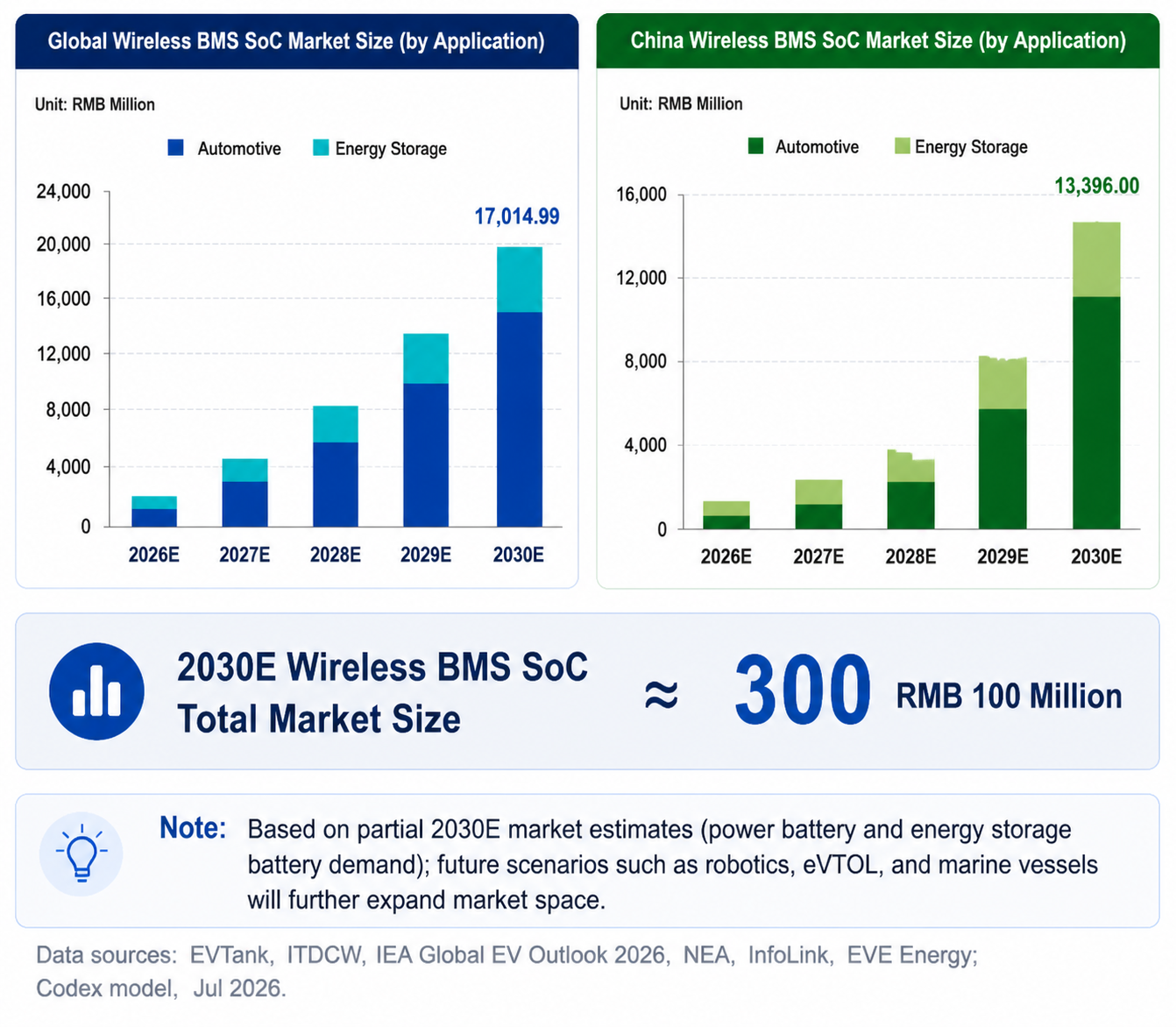
Global & China Market Scale of Wireless BMS
A power battery pack typically manages hundreds of battery cells, while large-scale energy storage systems oversee thousands of cells or more. Abnormality in a single cell may propagate thermal runaway across the entire module and even the whole battery system.
Serving as the "nerve center" of battery systems, BMS continuously collects critical parameters including voltage, temperature and current, and undertakes core functions such as state estimation, cell balancing control, fault diagnosis and safety protection.
However, a critical pain point emerges:
By the time conventional BMS detects conspicuous temperature spikes or voltage anomalies, internal cell hazards have already accumulated for a prolonged period.
This paradigm shift drives BMS evolution from post-fault protection to early hazard identification and proactive pre-warning.
As the number of cells inside a single battery pack surges from hundreds to thousands, conventional wired Battery Management Systems (BMS) are confronted with unprecedented complexity challenges. Against this backdrop, Wireless Battery Management System (wBMS) has emerged as a cutting-edge technological priority embraced by the global power battery and energy storage sectors.
Global Key Market Players & Industrial Landscape
Wireless BMS is not merely an upgrade to communication technology, but a system-level innovation covering cell sampling, wireless connectivity, functional safety, data security and system control. In recent years, leading global automotive semiconductor vendors have iterated products and platforms to facilitate the transition of wBMS from technical verification to mass commercial deployment.
Texas Instrument (TI)
TI is one of the early mainstream chip suppliers pioneering wireless BMS development. Leveraging battery monitoring Analog Front End (AFE), wireless MCU and software platforms, TI delivers a 2.4 GHz wBMS solution focused on resolving wireless connectivity, network management and functional safety challenges.
Core technical highlights
· Vehicle-level battery system-oriented wireless architecture
· Optimized low-power wireless communication protocols
· Seamless compatibility with TI’s legacy BMS AFE product ecosystem
NXP Semiconductors
NXP builds complete wireless BMS communication links and chip platforms centered on UWB, automotive-grade MCUs, automotive networking and mature functional safety frameworks.
Core strengths:
· UWB-based wireless communication architecture
· Robust automotive-qualified MCU and security architecture capabilities
· Comprehensive ecosystem for in-vehicle networks (CAN, Automotive Ethernet)
· Strict compliance with ISO 26262 functional safety standards
ADI
A global leader in BMS chips, ADI focuses on building fully integrated wireless BMS platforms that deeply combine high-precision battery monitoring, wireless communication, functional safety and software ecosystems to deliver system-level turnkey solutions for OEMs.
Technical features:
· High-precision battery monitoring: Ultra-accurate cell parameter sampling built on proven Battery Monitor AFE;
· End-to-end wireless platform: Integrated AFE, wireless SoC, wireless management unit and software suite for full-stack wBMS solutions;
· Full-lifecycle battery management capability
SENASIC
As a domestic pioneer in edge-side wireless intelligent cell chips, SENASIC innovatively integrates wireless communication, multi-dimensional sensing, edge computing and high-precision battery monitoring to deliver targeted intelligent management for individual battery cells.
Core technological advantages of SENASIC:
· Smart Cell: Intelligent management at the minimum battery system unit with real-time status monitoring for single cells
· Multi-dimensional fused sensing: Beyond basic voltage and temperature measurement, Electrochemical Impedance Spectroscopy (EIS) and multi-dimensional physical signals are incorporated to capture internal cell degradation and incipient faults
· Edge-side intelligent computing
· Low-power wireless communication
· Full-lifecycle data tracing capability
Leading domestic and overseas manufacturers have finalized foundational architecture validation for wireless BMS. The industry has shifted from debating "whether to adopt wireless BMS" to exploring "how to build an intelligent wireless battery management system". Wireless connectivity has become a baseline capability, while cell-level intelligent sensing and edge computing have become core competitive focuses for the next development stage.
How to Advance the Thermal Runaway Pre-warning Window? Capturing Incipient Precursor Signals
Thermal runaway is never an instantaneous isolated failure; it evolves gradually through internal micro-shorts, abnormal heat generation, intensified side reactions, gas evolution, voltage fluctuation and rapid temperature escalation.
Conventional BMS judges battery conditions solely based on voltage and temperature. While both metrics are essential for battery safety management, their response lags at the early fault stage:
Local micro-shorts develop with negligible overall temperature rise
Aggravated internal side reactions occur while terminal voltage remains within the normal range
Electrolyte decomposition and internal gas generation initiate without obvious external temperature elevation
Once voltage and temperature exhibit drastic deviations simultaneously, the actionable intervention window is drastically shortened.
Therefore, enhancing thermal runaway pre-warning capacity relies not only on higher sampling frequency, but also expanding observable physical dimensions and identifying correlated variations across multi-parameter signals.
BMS ASIC: The Chip Foundation Determining Detection Accuracy and Early Warning Timeliness
BMS ASIC is a mixed-signal application-specific integrated circuit customized for cell status sampling, signal processing, balancing control, fault diagnosis and safety protection.
Traditional BMS consists of discrete chips and massive peripheral components. Custom ASIC integrates high-precision analog front ends, ADC, diagnostic circuits, balancing switches, communication interfaces and partial digital processing modules, upgrading overall system precision, power consumption, footprint and reliability.
Core Modules of a Typical BMS ASIC
1. Analog Front End (AFE)
Directly interfaced with battery cells for:
Single-cell voltage sampling;
Temperature and external sensor signal reception;
Overvoltage/undervoltage monitoring;
Open-circuit fault diagnosis;
Cell balancing switch control.
2. High-Precision ADC
Converts analog signals to digital signals, with key performance indicators including:
Sampling precision;
Multi-channel consistency;
Synchronization performance;
Temperature drift suppression;
Common-mode rejection ratio;
Long-term operational stability.
3. Digital Control & Diagnosis Unit
Responsible for:
Data processing and filtering;
Parameter calibration;
Built-in self-test (BIST);
Fault classification and identification;
4. Communication scheduling;
Safety mode control.
Communication & Security Interfaces
Legacy wired BMS adopts daisy-chain, SPI, UART or isolated communication. wBMS adds wireless communication nodes with stricter requirements for data encryption, anti-tampering, anti-interference and network orchestration.
5. Low-Power Power Management Unit
Supports sleep mode, scheduled wake-up, threshold-triggered sampling and event-driven data acquisition to maintain low-power standby during warehousing, transportation and long-term operation.
Definition of wBMS
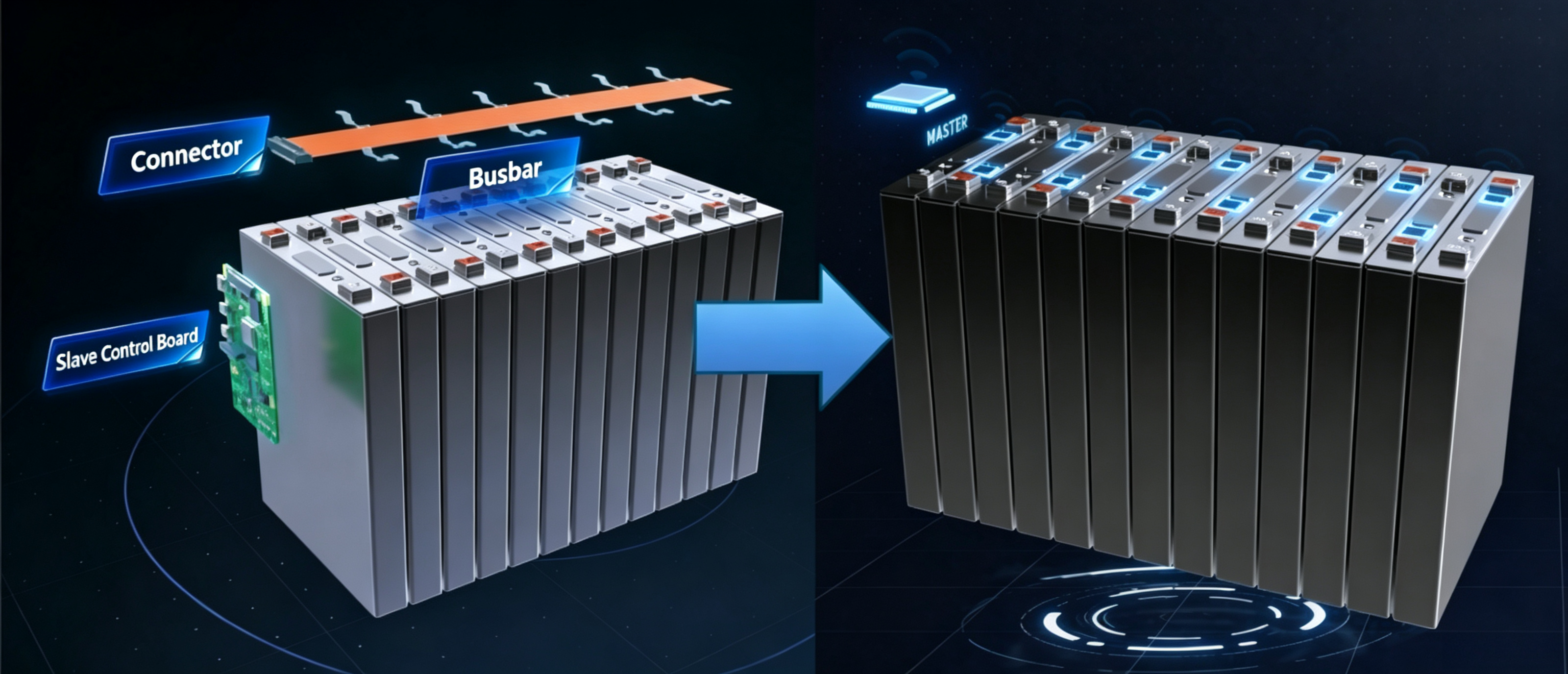
Conventional Wired BMS vs. Intelligent Wireless BMS Architecture
In traditional wired BMS, sampling harnesses and connectors transmit cell voltage, temperature and other data to Cell Supervising Controller (CSC), which aggregates data to the Battery Management Controller (BMC) for state estimation, balancing control and safety governance.
Wireless BMS replaces physical sampling harnesses with wireless communication for real-time cell data transmission, delivering superior layout flexibility and scalability for battery pack design.
Core Value Propositions of wBMS
Enhanced Safety
Multi-dimensional sensing (voltage, temperature, EIS, expansion force, air pressure, etc.) enables high-fidelity monitoring and early fault pre-warning.
Full Lifecycle Management
End-to-end traceability across manufacturing, transportation, warehousing, operation and second-life utilization to extend battery service life and cut O&M costs.
Improved System Reliability
Eliminates harnesses, connectors and high-voltage wiring points to reduce mechanical failure risks and boost intrinsic safety.
Harness Simplification & Lightweighting
Reduces battery pack weight, optimizes layout space, supports platformized design and flexible manufacturing, and lowers wiring material and assembly costs.
At SENASIC, Physical AI is defined as AI that perceives, interprets and interacts with the physical world. For battery systems, the physical carrier is every single electrochemical cell. By fusing multi-dimensional physical signals including voltage, temperature and EIS, edge-side cell-level analytics identifies early degradation, micro-shorts and severe side reactions, and feeds insights into pack-level safety decision-making via wireless networks.
By eliminating sampling harnesses, connectors and physical wiring joints, wBMS reduces system complexity and long-term mechanical connection failure risks. System reliability no longer hinges on wiring quantity but is determined by wireless communication robustness and functional safety design.
For new energy vehicles, wBMS prioritizes lightweighting, space utilization and assembly efficiency. For energy storage systems, its core value lies in long-term operational efficiency.
Energy storage cabinets often accommodate thousands of cells and require stable operation for over a decade. wBMS streamlines on-site deployment, continuously collects cell operational data to support lifespan prediction, pinpoint fault localization and predictive maintenance. This reduces the Total Cost of Ownership (TCO) of energy storage systems and maximizes the residual value of energy storage assets throughout their service cycle.
Core Technical Challenges for wBMS
Communication Reliability
The metallic enclosed battery pack creates severe signal shielding and attenuation. Key challenges include multipath interference, metal shielding attenuation and stable low-power communication.
High-Performance Chip Design
Chip high-reliability engineering, high-precision sensor sampling, ultra-compact packaging integration technology
Information Security
Wireless links must satisfy automotive-grade security specifications: end-to-end data encryption, anti-tampering mechanisms, strong electromagnetic interference resistance
Power Consumption & Form Factor
Cell-side nodes require ultra-low-power continuous operation and miniaturized packaging for seamless integration with battery cells.
From "Data Sampling" to "Active Perception": Every Cell Evolves into an Intelligent Node
Wireless connectivity is merely a foundational upgrade, not the ultimate target.
Conventional BMS relies on limited parameters (voltage, temperature) for condition assessment. Driven by advanced sensing, wireless communication and edge computing, individual cell nodes gain the capability to analyze multi-source data independently. The transformative breakthrough for the industry is the intelligence embedded within every single cell.
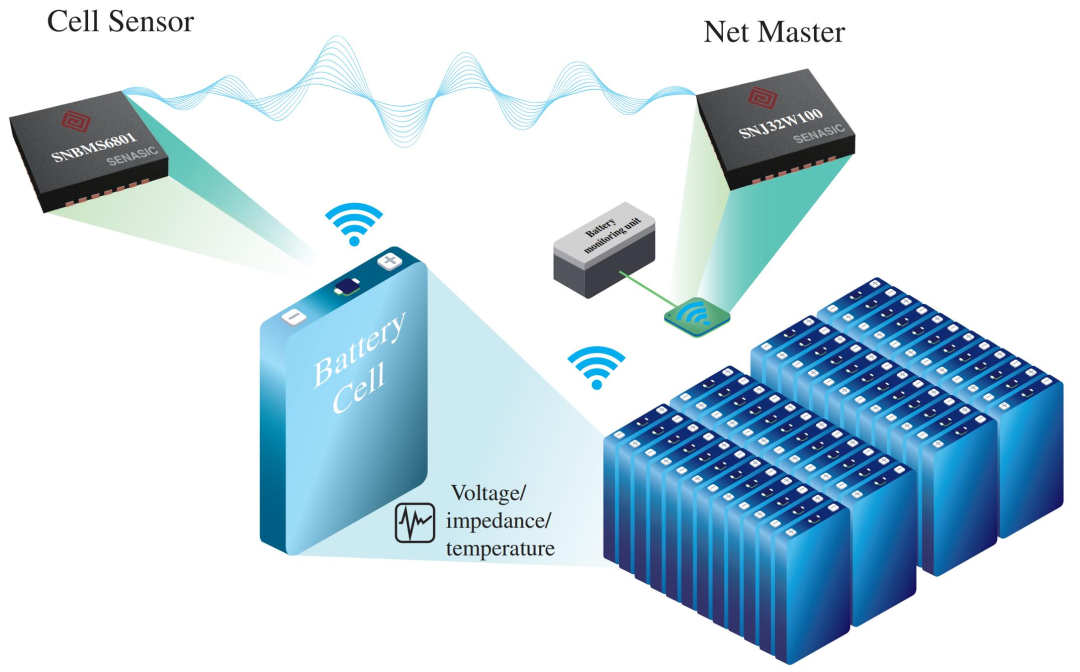
Architecture of Edge-side Intelligent Wireless Battery Management Chip
In this new paradigm:
Single cell = Independent intelligent sensing node
Battery pack = Distributed wireless sensing network
Central system & cloud platform = Energy dispatch & full-lifecycle operation hub
Next-generation BMS integrates expanded sensing dimensions:
Voltage, Temperature, Electrochemical Impedance Spectroscopy (EIS), Pressure, Strain, Expansion deformation, Gas composition and other extended sensor signals
This marks the architectural transition of battery systems from centralized control to edge intelligence + system collaborative governance.
With the official enforcement of the EU Battery Regulation and rollout of the Battery Passport scheme, the commercial value of granular single-cell operational data has risen sharply.
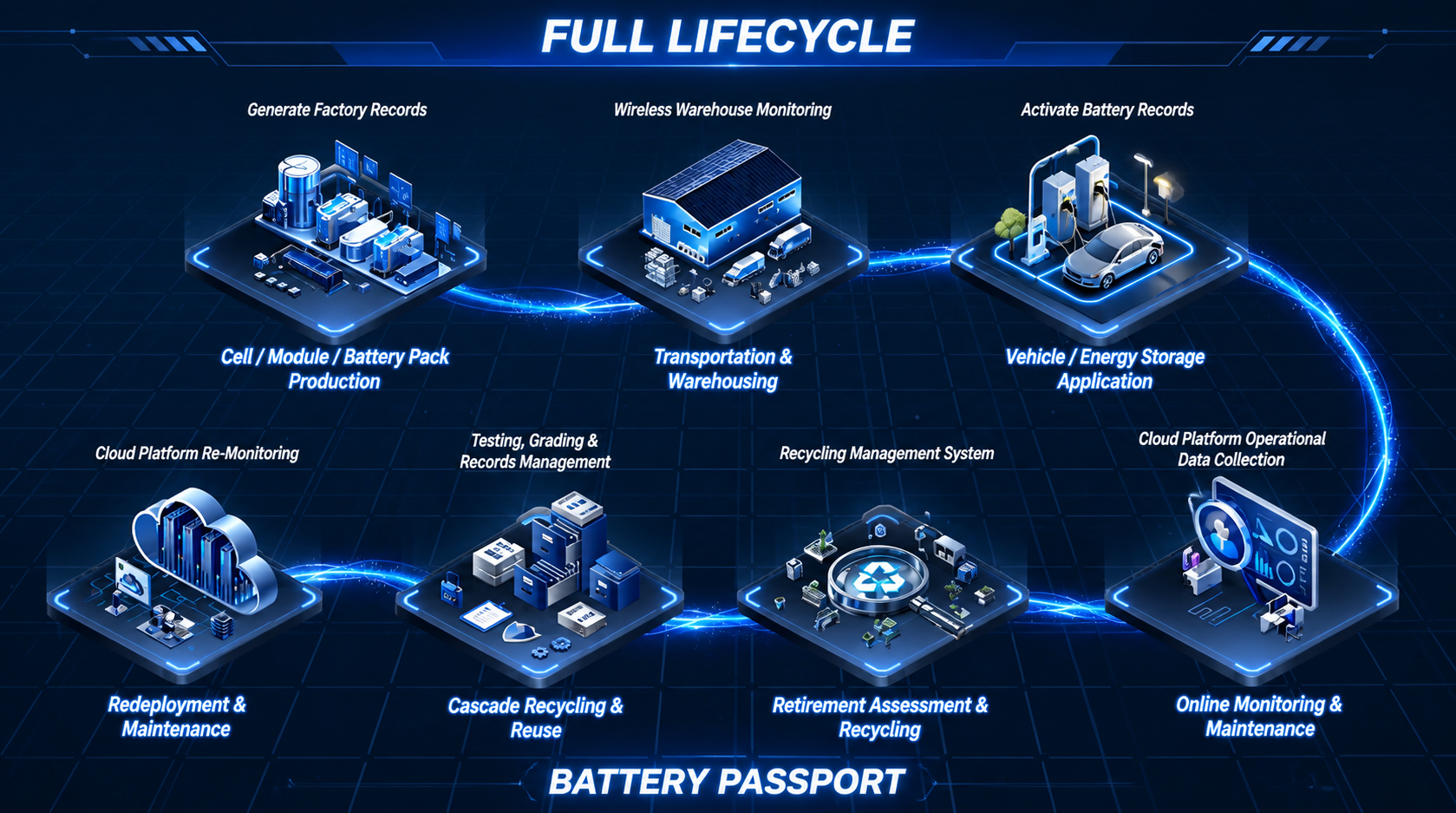
Full-lifecycle cell traceability enabled by Battery Passport
Continuous, complete and credible single-cell data serves as the core basis for battery health evaluation, lifespan forecasting and residual asset valuation across battery manufacturing, vehicle operation, energy storage deployment, retirement assessment and secondary utilization.
Future BMS will act not only as a safety control unit, but also as the digital infrastructure underpinning the entire battery lifecycle.
From "Temperature Measurement" to "Comprehensive Battery Profiling": Why EIS Gains Strategic Importance?
As BMS evolves toward intelligence, voltage and temperature alone fail to meet the requirements for incipient fault detection. Electrochemical Impedance Spectroscopy (EIS) has become a focal research direction for wireless BMS and Smart Cell development.
If voltage reflects instantaneous output performance and temperature reflects external thermal status, EIS acts as an internal "health checkup report" for batteries, characterizing internal electrochemical reactions to quantify State of Health (SOH) and degradation trends.
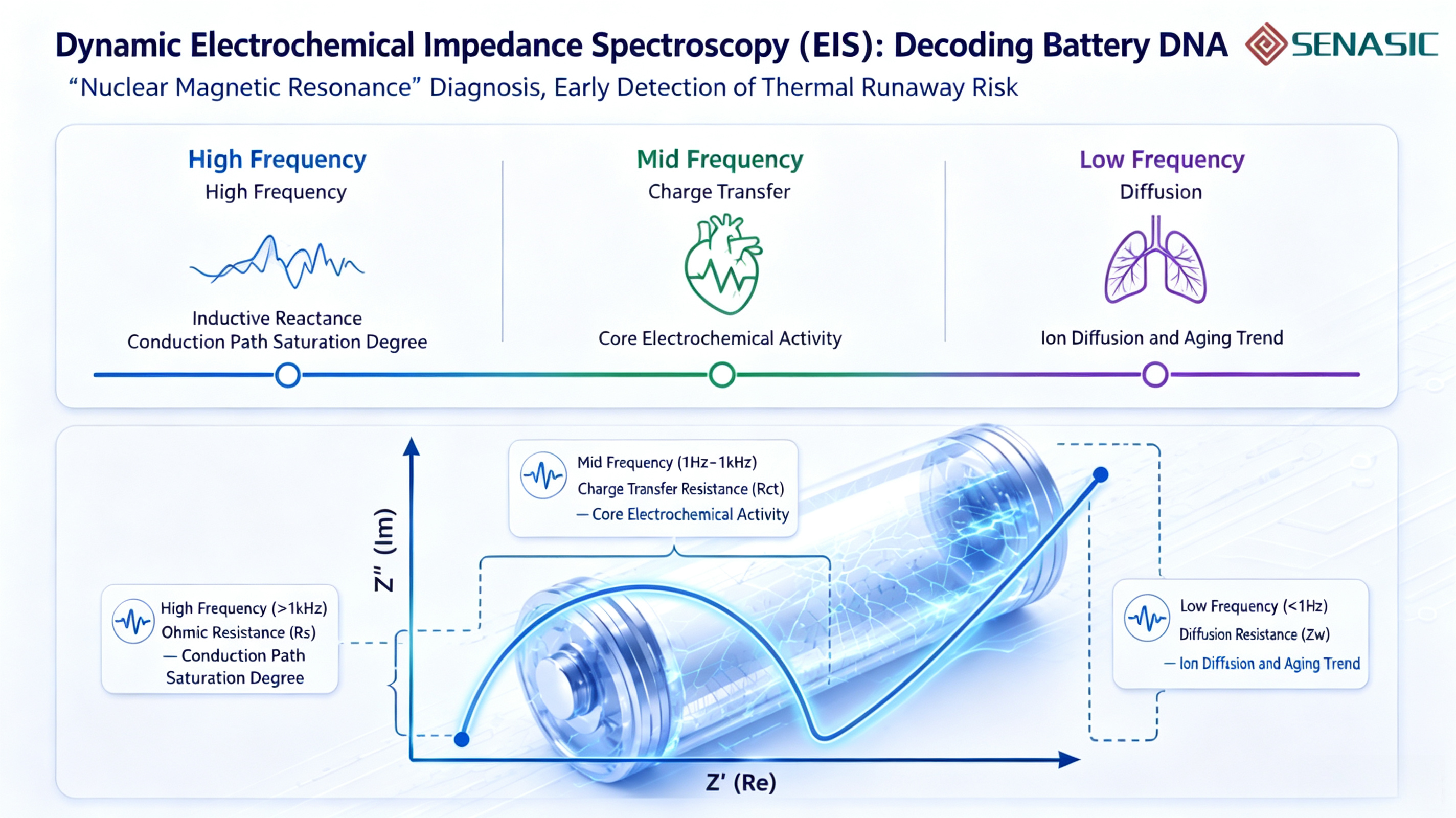
EIS resolves internal electrochemical conditions via impedance response across multiple frequency bands
Why EIS Detects Abnormalities Earlier Than Surface Temperature Monitoring?
Conventional BMS measures cell surface temperature via NTC thermistors. When internal micro-shorts, intensified side reactions or localized heat generation occur inside a cell, heat dissipates outward through layered cell materials, leading to significant lag in surface temperature readings.
In contrast, impedance variations emerge simultaneously with electrochemical changes. Alterations to internal reaction conditions directly trigger shifts in ohmic impedance, interfacial charge transfer impedance and diffusion impedance. Thus, EIS captures internal cell degradation far before overt temperature rise, extending the response window for thermal runaway mitigation.
To summarize:
Surface temperature measurement detects heat that has escaped the cell;
EIS detects electrochemical degradation initiating inside the cell.
SENASIC believes the core competitiveness of next-generation BMS shifts from raw data collection to intelligent data interpretation. Capitalizing on EIS’s strength in internal cell condition profiling, SENASIC performs fused analytics on EIS, voltage, temperature and other core parameters to build comprehensive cell health portraits for SOH evaluation, anomaly detection and ultra-early thermal runaway warning. Each cell upgrades from a passive data collector to an autonomous intelligent sensing node, accelerating the industry transition of wBMS to the Smart Cell architecture.
Tier 1 & OEM Playes in China's BMS Market
Enterprise Type | Representative Companies |
Power Battery Giants | CATL, Sunwoda, BYD |
Vehicle OEMs | BYD、BAIC BJEV |
AI BMS & Cloud Intelligent Solution Providers | HUAWEI |
(Source: Official corporate websites, XinchaCha Database)
Key Data on Domestic Substitution for BMS Core Chips
Localization rate of core BMS chips: 28% (2021) → 65% (2024)
Technical Milestone: Mass production of BMS chips fabricated on 12nm process
SiC penetration rate in BMS power modules: 18%, representing a 7% year-on-year increase versus 2023
SENASIC:Edge-side Wireless Intelligent Chip Solution for Next-Generation Smart Cell Systems
Aligned with industrial trends, SENASIC is one of China’s earliest chip developers dedicated to custom ASICs for single-cell wireless BMS. The company integrates wireless communication, multi-dimensional sensing and edge-side intelligent computing to launch cell-level wireless intelligent solutions for power batteries and energy storage systems.
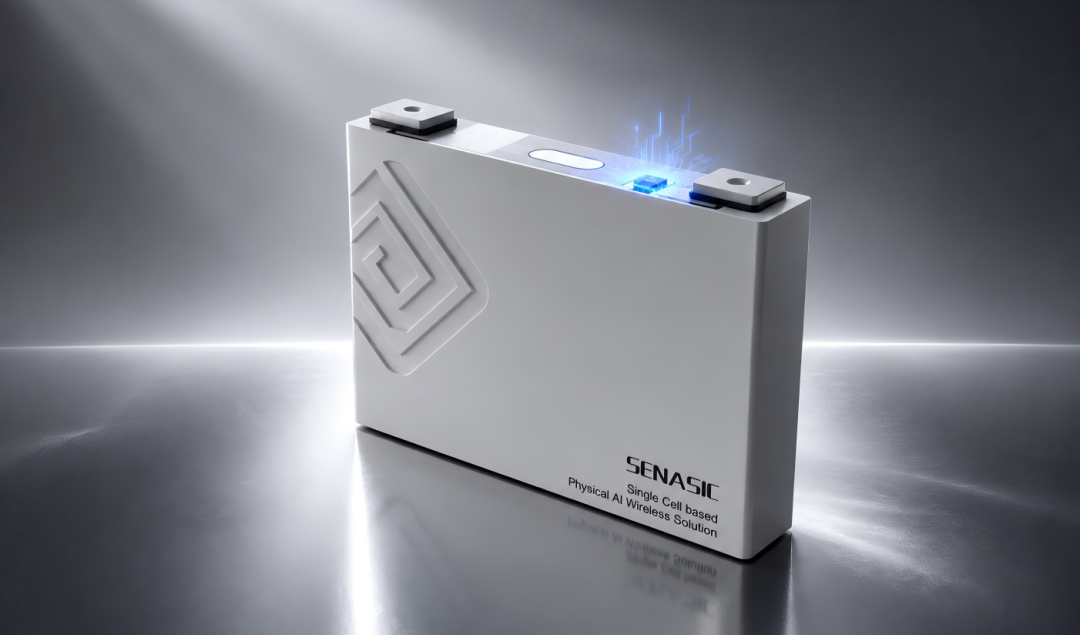
SENASIC Physical AI Edge-side Wireless Intelligent Solution for Single Cells
Core Capabilities of Cell-level Wireless Intelligent Solution
1. Single-Cell Refined Management
Break the limitations of module-level monitoring for finer-grained cell anomaly identification and condition tracking.
2. Wireless Connectivity
Eliminate complex sampling harnesses to enhance system integration flexibility and operational reliability.
3. Multi-Dimensional Sensing
Fuse voltage, temperature, EIS and key physical parameters for comprehensive internal cell condition analysis.
4. Edge-Side Intelligent Computing
Local data processing and algorithmic analytics for ultra-fast anomaly detection and proactive hazard alerts.
5. High Safety & Robustness
Real-time battery status monitoring to strengthen thermal runaway risk identification capability.
6. Full-Lifecycle Data Governance
Build an end-to-end cell data chain covering manufacturing, in-service operation and retired battery utilization.
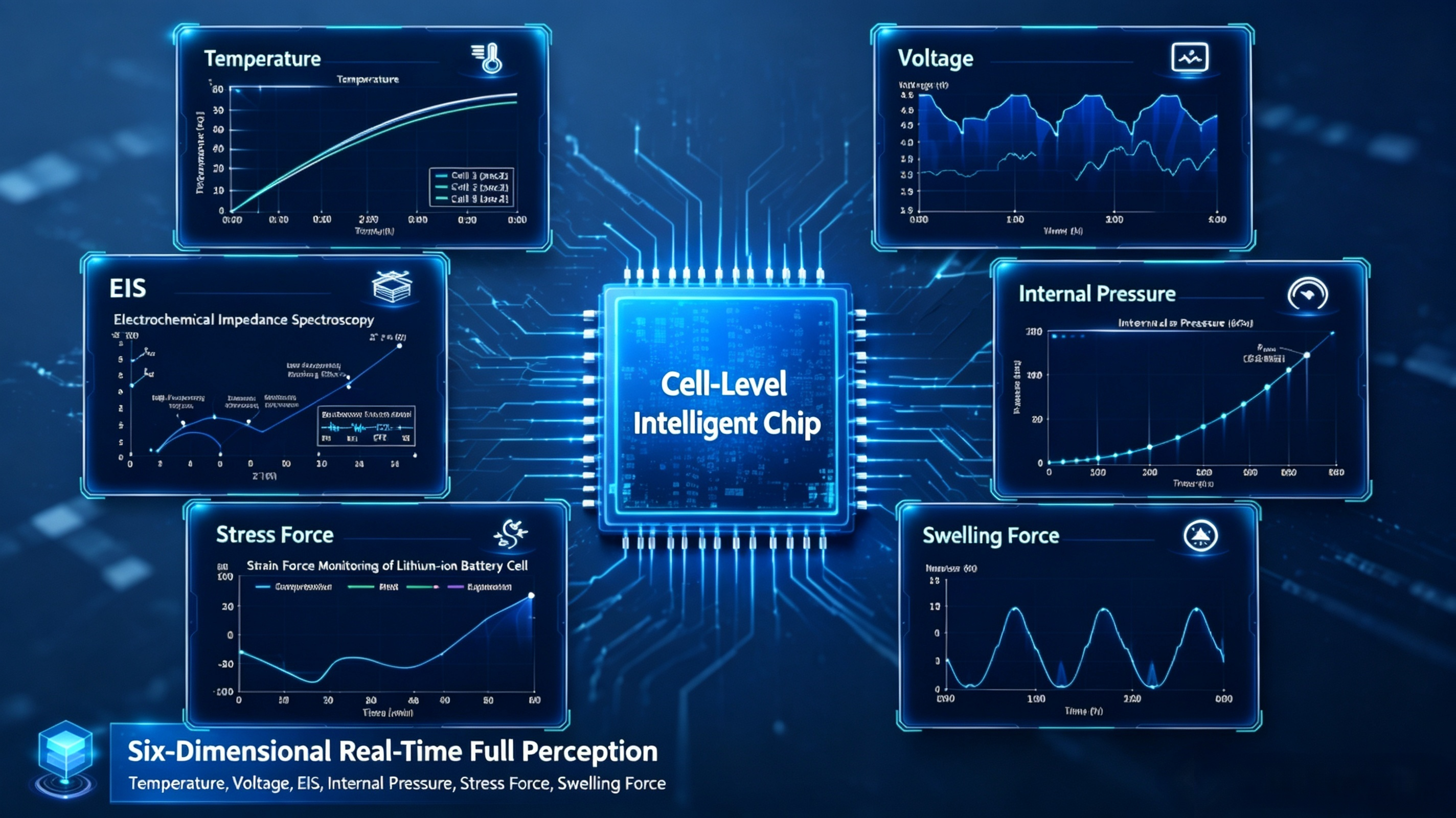
SENASIC Cell-Level Intelligent Chip: Multi-Dimensional Real-time Profiling of Internal Cell Status
Unlike conventional BMS focused on module or pack-level data aggregation, SENASIC’s wBMS solution centers on the smallest management unit — individual battery cells. Real-time sampling of voltage, temperature, EIS and other critical parameters, paired with edge-side algorithmic analysis, delivers actionable insights including:
State of Health (SOH) assessment
State of Charge (SOC) estimation
Abnormal cell fault identification
Advanced thermal runaway pre-warning
End-to-end battery lifecycle management
All supported by high-precision, reliable foundational data.
Future Outlook
The evolution of wireless BMS revolutionizes not only physical wiring architecture, but the underlying logic of battery management.
The industry transitions from centralized control to distributed edge intelligence, from raw data acquisition to proactive physical perception, and deep collaboration between edge computing and embedded AI. Battery systems evolve into distributed wireless sensing networks composed of massive Smart Cells.
When every cell can continuously self-monitor health status, perform real-time operational analytics and achieve secure interconnection, batteries evolve from simple energy storage devices into digital intelligent assets spanning manufacturing, operation, maintenance and secondary utilization.
The future value of BMS extends beyond safety control to data monetization and intelligent decision-making capability, driving the iteration of BMS chips from discrete monitoring components to integrated platforms combining "sensing + communication + computing".
In response to this industrial transformation, SENASIC will continue to deepen R&D on edge-side wireless intelligent chip technology, facilitate deep integration of wireless connectivity, multi-dimensional sensing and edge AI, and construct safer, more efficient and intelligent next-generation battery management infrastructure for new energy vehicles, energy storage and diverse smart energy scenarios.
Related Articles
-
2023-06-26Senasic cutting-edge technology: High reliability, high precision — Resistive dual-channel sensor interface chip SNU511
-
2023-06-08Senasic cutting-edge technology: Tire Safety Monitoring for Safe Driving — High-Integration Bluetooth Tire Pressure Monitoring Chip SNP736
-
2023-03-14Senasic cutting-edge technology: Universal Sensor Interface Chip USI — SNU301
