


Next-Gen Battery Passport & New Thinking on Battery Safety Sensing | Live Coverage of SensorChina2026
- 2026-09-19
- Exhibitions
On September 16, 2026, Sensor China 2026 grandly kicked off in Shanghai. As an innovative enterprise in the field of edge-side wireless intelligent sensing, Wen Li, Technical Director of SENASIC, was invited to deliver a keynote speech From Pack-BPS to Cell Internal Pressure: Physical AI Empowers Full-Domain Battery Safety Monitoring at the Forum on Integrated Development of Sensors and Physical AI. He shared insights with industry experts, customers and partners on-site regarding the development trends and future directions of battery safety monitoring technologies.

Wen Li, Technical Director of SENASIC, delivers the keynote speech
Driven by the rapid growth of energy storage systems, new energy vehicles, drones and other applications, battery systems are evolving toward higher energy density, larger scale and longer service life, which continuously elevates the importance of safety management.
Industry requirements for thermal runaway early warning are also upgrading from conventional monitoring toward earlier, more accurate and finer-grained safety sensing.
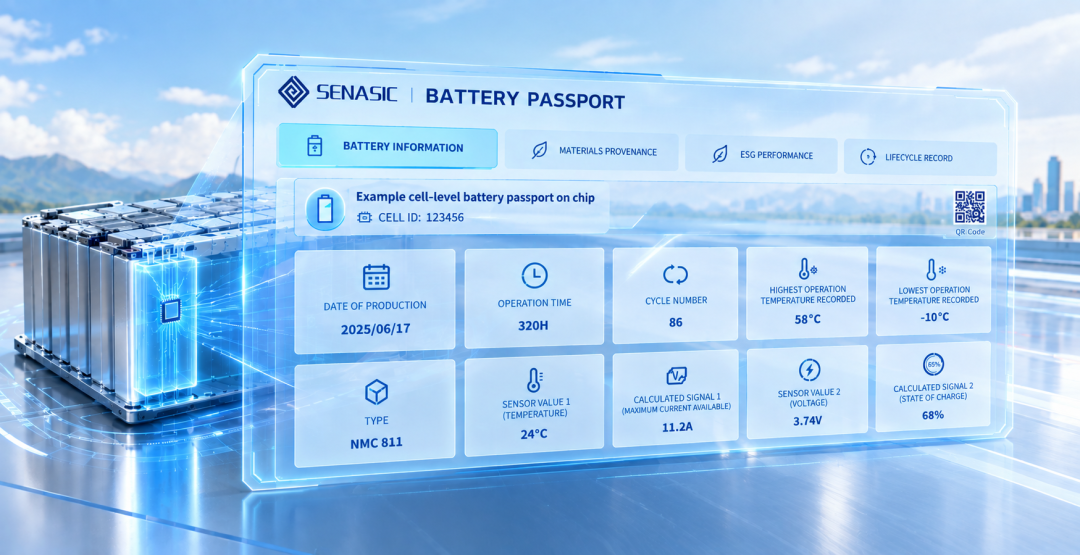
Battery Passport: Full-Lifecycle Traceability of Battery Cells
Ranging from real-time cell-level sensing to full-lifecycle data accumulation, the Battery Passport does more than record where a battery comes from. It continuously archives authentic status data of every single cell throughout production, operation and recycling, making the full battery lifecycle perceptible, traceable and manageable.
In his speech, Wen Li systematically presented the current status and technical evolution roadmap of battery pack sensors. Battery safety monitoring is advancing from pack-level sensing to cell-level sensing: starting from basic parameters including voltage, current and temperature, then moving to multi-modal sensors such as BPS, gas, smoke and leakage sensors, and further extending to emerging sensing dimensions like cell internal pressure, expansion force and EIS (Electrochemical Impedance Spectroscopy).
The speech also highlighted new opportunities brought by wireless BMS. The wireless architecture not only simplifies wiring harnesses, but also creates physical prerequisites for sensors to sink down to cell level. It enables deployment of diverse sensing functions directly on individual cells to achieve richer data acquisition and more accurate state recognition.
Leveraging smart cell ICs and wireless BMS technologies, SENASIC is actively exploring integrated cell-level sensing solutions covering internal pressure, expansion force, temperature and other parameters. The solutions deliver earlier, more accurate and smarter safety sensing capabilities for power batteries, energy storage systems, drone batteries and other scenarios.
Future Outlook
Going forward, SENASIC will continue to deepen its expertise in edge-side wireless intelligent sensing. The company will keep innovating around wireless BMS, smart battery cells, multi-sensor fusion and edge intelligence technologies, and promote deep integration of Physical AI with battery safety management. It enables real-time acquisition, precise interpretation and efficient utilization of critical physical-world data. Committed to becoming the sensing-and-computing entry point for Physical AI deployed in the physical world at the edge, SENASIC strives to contribute to a safer, smarter and more sustainable energy future.
— Make every single cell visible.